NEWS
IN CASE YOU MISSED IT, Tappeto Volante Gallery
JUly 10 - august 22, 2026New York, NY
Visiting Artist: Maryland Institute of Art, Low Residency MFA
june 30 - JUly 1, 2026BALTIMORE, MD
Freewheeling, UPSTATE ART WEEKEND
june 25 - JUNE 29, 2026GHENT, New york (MEG LIPKE's STUDIO)
The first time I heard of Annette Wehrhahn, I was standing in front of a huge painting of hers at a mutual friend’s apartment. It was an extraordinary work! At once garish, glamorous, cool, and vulnerable—it was total magic. When I finally met her several years later, it was during the preparation for Soloway gallery’s inaugural show, Parts and Labor, in 2010. Annette and three other friends, one of whom, Munro Galloway, was the person who had Annette’s dazzling painting in his living room, had just opened the space in Brooklyn and invited about forty artists to contribute small works. Years later, Annette and I had a two-person show at Safe Gallery in Brooklyn in 2016, and then traveled together to Luxembourg for an exhibition curated by Wallace Whitney at Ceysson & Bénétière Gallery in 2017. I still smile when I remember how much we laughed and the many stories she told me as we worked on those shows. Annette and I had a really strong connection right when we met and have been big fans of each other’s work since.
Annette lived behind Soloway for seven years and was the director for eleven. Her current solo exhibition at the gallery, Human Remains, marks her retirement as director after these many fruitful years.
—Fabienne Lasserre
Fabienne Lasserre: I love visiting your studio. It is a total mess—a beautiful, fertile, layered mess. You work horizontally, and all of your pieces—finished and in progress—are stacked on top of each other on the floor. There is no way to walk around them; as soon as you enter the studio, you have to walk on the stacked pieces. How does your “mess”—which I take to be a kind of welcoming of the world, of your life as a whole, into the very movements and gestures of your processes—influence or affect your work, that is, how does it make your work possible?
Annette Wehrhahn: Oh, my god, Fab, this question is so good it doesn’t even need an answer. I can just smile and nod my head and we’re done. Finally someone appreciates my messiness! We might need to get married. I really love that you used the word “fertile” because there is something about having things strewn around that is a bit like scattering seeds to see which ones grow. The mess helps me keep things loose and keeps me open to unexpected possibilities and prevents the anxiety I feel when standing in front of a beautifully primed and stretched white canvas, afraid I might ruin it. I want to have a familial relationship with my work where we live together and show our flaws, not a put-your-game-face-on professional or first-date kind of thing. It’s the primordial soup! Unexpected clashes and splits generate new life forms. I want to keep the stuff we’re supposed to clean up, hide, or buff out. That’s where all the juicy, interesting bits are.
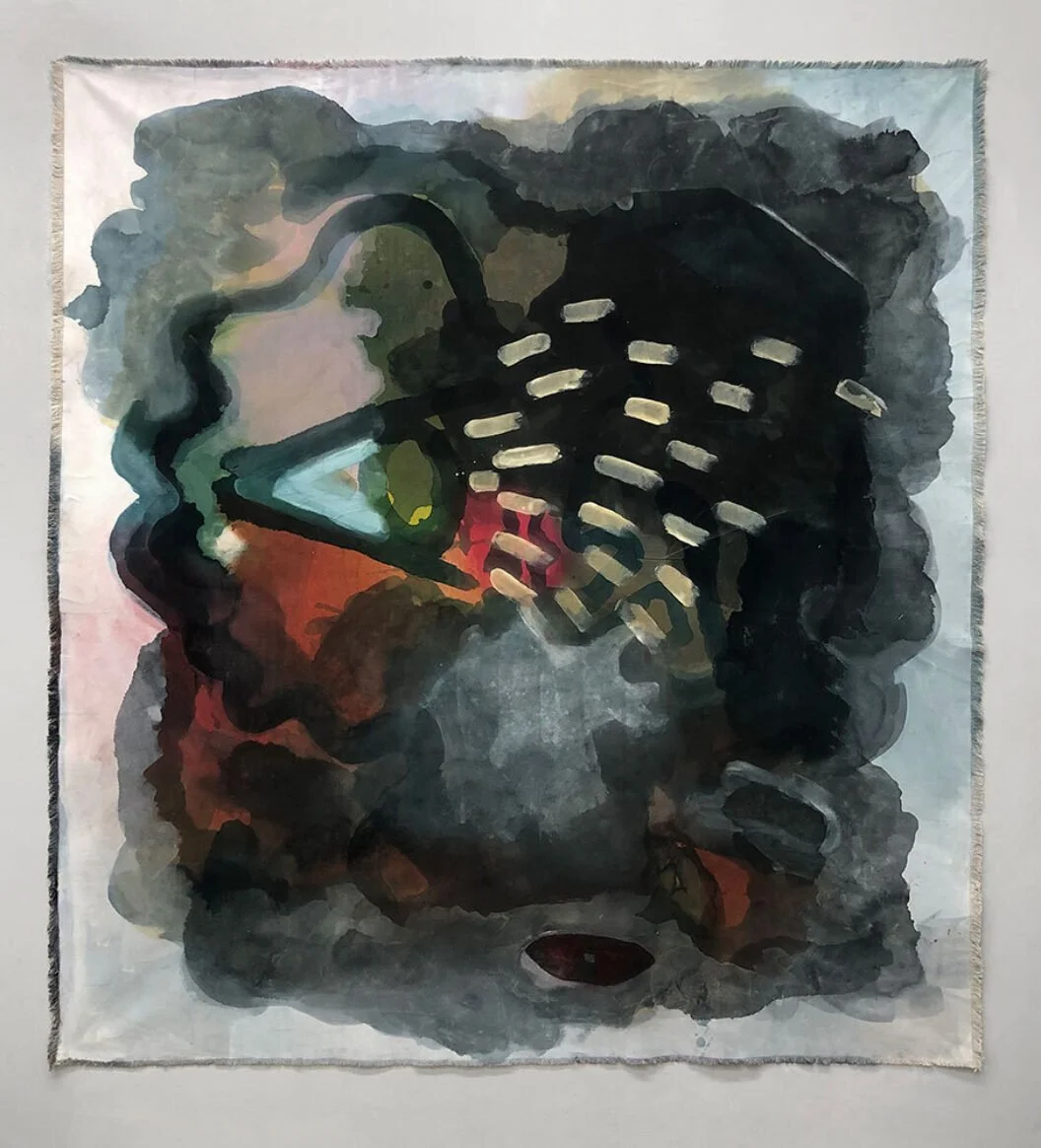
Nite Vision, 2021, watercolor on canvas, 79 x 70 inches
FL
When I look at your work, I don’t fully understand what the piece is doing to me or how. The mystery, the part that continually escapes me, keeps me interested. Is that—the part that always eludes us—what you’re after when you create? What “escapes” you, and how do you reach for it?
AW
I’m so happy you said that. It’s exactly what I’m going for! My ideal image is one that is kind of emerging and disappearing at the same time. Barely there. I think about the permeable membrane between things, like a line that isn’t there anymore, but you fill in the pieces. It feels really good on my eyes to do that. Working up-close on the floor and later setting things upright I think—hope—also keeps the pieces from getting too stuck in gravity. I want them to be kind of floating.
FL
Are things ever finished? Are they always on the way to something else?
AW
In the process of developing the work there are often a bunch of stops on the train that might be good for finishing. There’s some risk involved in continuing on when you have something halfway decent because things get ruined or overworked, and there’s no way back. When I finish a session of painting, I can’t always tell if something is done or if it’s good. To get around that I work on many pieces at the same time so I don’t get too attached. I put things away for a while so that I can get a critical eye again with a fresh look. Recently I’ve been experimenting with leaving things at different densities so that sometimes something that would normally be a base layer might be compelling enough to keep. I want to override my natural instinct to balance things and clean them up. I want to find something good in an unexpected way and not in a known and balanced design way. I now also consider that something with very little might be done and another work might need a lot more on it. They each establish their own terms.
FL
What kind of role does enchantment play in your processes and work? Care? Devotion? Tell me about the cosmogonies and belief systems that inform your work and outlook.
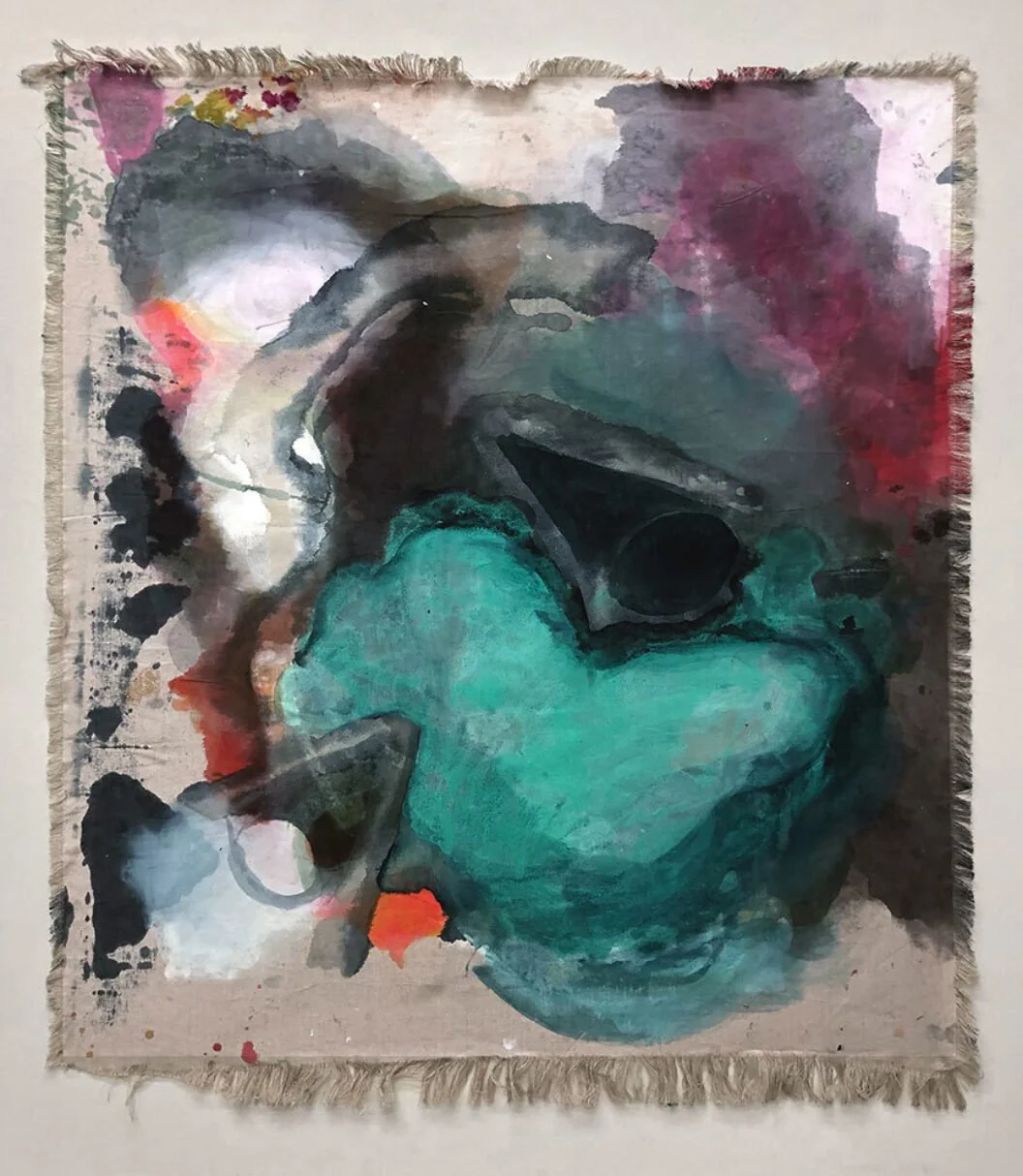
Untitled, 2021, watercolor and oil on canvas, 60 × 54 inches.
AW
Enchantment is such a great word; it touches on so much without setting off the alarm bells that magic and spirituality do. So many things inspire me, and I like to let them occupy my subconscious and permeate the work. There are some major through lines that directly lead me to where I am. I first returned to the body through an interest in cave paintings, or I guess I got interested in cave paintings after I traced myself on canvas to imagine how to make a clothing pattern. When stood upright, the outlines of my body turned into piles of tumbling limbs. I wanted to portray movement, defy gravity, and invite viewers to imagine themselves falling. It’s the view of the body as seen from the inside, looking out at itself. The earth-red and ochre pigments, the portable canvas, my living situation in a tiny space behind Soloway at the time got me relating to our ancestors in caves. Moving from place to place and making paintings because of an innate human need resonates with me.
FL
I feel that you paint the body as something that can be reconfigured, shifted, and even played with. At the same time, bodies and body parts in your work are invested with sacredness; they stem from myth, are the grounds for cosmogonies, or seem to partake in “practical”—down and dirty—systems of magic. There is even a bodily engagement with color in your work. Glamour, style, and humor are thrown in too. Tell me more about that. Also, what are the political stakes of your uses of the body?
AW
A bunch of years ago I visited Italy and was struck by the displays in churches of small, metal reliefs depicting fragments of the body. They’re called ex-votos and are placed in chapels by people seeking cures for ailments and as signs of gratitude by those who have been cured. The accumulation of these isolated body-part objects out of scale with one another creates a quilt-like portrait of the humans who have visited and left their signs of devotion and belief. It’s such a contrast to the perfect Renaissance depictions made by one male master and permanently affixed in frescos. And formally, with this as my guide, I wasn’t restricted to my body, and I could play with scale and color, and things could be absurd in relation to one another. I spent a long time working with Venus-type figurines and other fertility figures found at ancient sites. With their giant boobs and pin-size heads, they are magical cartoons from the past. They’re hilarious but also really moving, and that’s the combination that most reflects life the way I want to represent it. For this show at Soloway I’m working around the idea of the bust or a portrait in the loosest imaginable way. I recently saw Willem De Kooning’s women at the Barnes Foundation in Philadelphia, and they were magnificent. Then I saw one that Joan Snyder made that blew all of those out of the water. It’s another fragment of the figure with an epic history, but it’s also three goofy circles on a canvas.
FL
I can look at your paintings for hours. Things are constantly shifting and reverberating, like the movement of light on water. Your colors are vibratory, and so is the materiality. Things seep, flow, stain, emerge, and transform. Tell me about this liquidity and metamorphosis in your work.
AW
I started working wet on wet during the pandemic with these saturated vinyl watercolors from Robert Doke. He taught me how to make oil sticks, and we shared an admiration for Emil Nolde’s watercolors. (German Expressionism is my first great art love.) The colors of this paint are so vibrant and intense that it’s possible to make something like a giant watercolor with them on canvas. I never use brushes, ever, just these giant carwash sponges. I wet the whole canvas and work wet on wet. After it dries I can add more layers and get some opaque white to erase things. The flowing nature of the colors is fantastic to me. It looks like it’s still moving after it dries. I’ll use oil sticks on top of that, and contrast is compelling to me. The speed of that material is so different. Oil sticks are creamy and slow, and I rub them in with my fingers and rags. They’re like giant artist crayon lipsticks and look casual in a way I aspire to. It’s so much work to look so casual!